
Digitainability is a serious game built to foster systems thinking in interdisciplinary workshops. Developed through an iterative process of expert interviews and academic research on green hosting and digital sufficiency, the game creates a shared vocabulary by exposing the fundamental friction between technological advancement and ecological impact.
Hand-drawn 2D graphics and minimalistic two-frame animations prioritize sustainability in production. Built in Unity with zero AI-generated content to minimize the project's carbon footprint. Gameplay relies on forced cooperation. Two players must trigger actions simultaneously to progress, establishing a simple but highly effective foundation designed for a future mobile-first release.
Dynamic Minigames
The Circuit Puzzle: Strategically align tech and eco-components to build functioning, sustainable circuits.
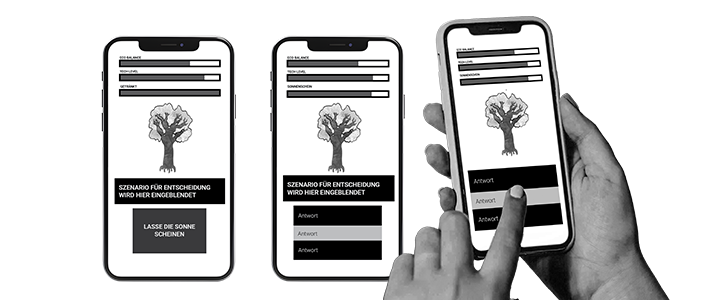
The Decision Tree: Navigate sequential everyday scenarios to balance the collective "Eco Balance" and "Tech Level."
The Server Room: Synergistically manage server capacities and cooling systems under intense time pressure.
You can find the whole playthrough → here.
My Contribution: Minigame 2 - The Decision Tree
What started as a simple text-based quiz evolved into a complex, scenario-driven cooperative challenge to better fit our core mechanic of forced collaboration.
Asymmetric Co-op Mechanic: I created a sequential collaboration system where players must work together simultaneously. While one player evaluates an everyday sustainability dilemma, the other is assigned "Plant Care," needing to actively manage sun and rain via repeated keystrokes.
Simultaneous Input: To lock in an answer, both players must press their respective buttons at the exact same time, enforcing constant communication.
Systemic Balancing Act: Player choices don't just yield "right or wrong" results; they directly impact an "Eco Balance" and a "Tech Level" bar. I implemented the game logic so that players start at 50/50 and must compromise to keep both bars in the optimal 40–60 range.
Dynamic Visuals: Working with Pavi's high-contrast designs, I used state machines in Unity to visually link the tree's health to the players' score. If the bars drift out of balance, the tree degrades—the Eco bar affects the leaves, while the Tech bar impacts the trunk.
Content Integration: I integrated 10 distinct scenarios based on our expert interviews, keeping them deliberately concise to fit the UI.
Testing & Future Iterations
Playtesting revealed that the systemic choices were highly challenging, and the initial UI was too dense, distracting from the tree’s visual feedback.
If this project went into production I would adjust the weighting of the answers to provide more "room for error." Also, I would aim to port this to a mobile-first format where players receive asymmetrical information on their individual screens, further forcing verbal dialogue.
The Interactive Web Poll (Workshop Icebreaker)
To bridge the game with the real-world workshop setting, I developed a live, interactive entry poll designed to map participants on an "IT vs. Ecology" spectrum.
Users scan a QR code leading to a mobile-friendly HTML questionnaire where they assess their background and submit their personal definition of sustainability. To visualise this, I built a presentation dashboard that shows the room's average score in real time and generates a dynamic word cloud of the submitted definitions of sustainability. We used this icebreaker to foster interdisciplinary exchange. The backend logic automatically groups participants into pairs (or trios) by matching individuals with the largest possible differences in their spectrum scores.
I developed and hosted this standalone tool on a private server using a custom HTML frontend and a PHP/Database backend for secure, real-time data processing.
Credits
Developed alongside Pavi (Character Design & Animations, Overall Game and Concept), Selina (Interview Framework & Research, Mini-Game 1) and Camilla (Mini-Game 3) in collaboration with our practical partner Joséphine. Special thanks to our lecturer, Chris, for the crucial impulse behind the core mechanic.


